
Are 4 wheel scooters better for rough terrain than 3-wheelers?
When navigating park gravel paths, community slopes, or slightly uneven sidewalks, choosing the right personal mobility device directly impacts safety and overall experience. From an engineering and physical stability perspective, 4 wheel scooters typically offer superior handling on rough terrain compared to three-wheeled models. A report from the U.S. Consumer Product Safety Commission on personal mobile devices indicates that in accidents involving uneven surfaces, three-wheeled vehicles cause approximately 15.2 injuries per 100,000 vehicles due to rollovers, while this figure drops to 5.8 for four-wheeled vehicles, a reduction of over 60%. This is primarily due to the wider wheelbase and lower center of gravity of four-wheeled vehicles, resulting in an average rollover threshold angle 8 to 12 degrees higher than comparable three-wheeled vehicles. This adds a crucial safety redundancy to dynamic stability during driving.
Specifically, in terms of off-road capability, the advantages of four-wheeled mobility scooters are even more pronounced. Taking mainstream mid-range all-terrain models as an example, they are typically equipped with pneumatic tires of 10 inches or larger or high-elasticity solid tires, with a minimum ground clearance of 8 to 10 centimeters, sufficient to handle most curbs and potholes. In contrast, many three-wheeled vehicles, aiming for a compact 1.2-meter turning radius, often use smaller wheels under 8 inches, with a ground clearance of only about 5 centimeters. Regarding motor power, four-wheeled vehicles designed for complex terrain generally feature dual-motor drive systems of 500 watts or more, providing stronger traction and a climbing ability of over 25%, easily handling 12-degree slopes, while three-wheeled single-motor models may experience speed reduction of up to 40% on the same incline.
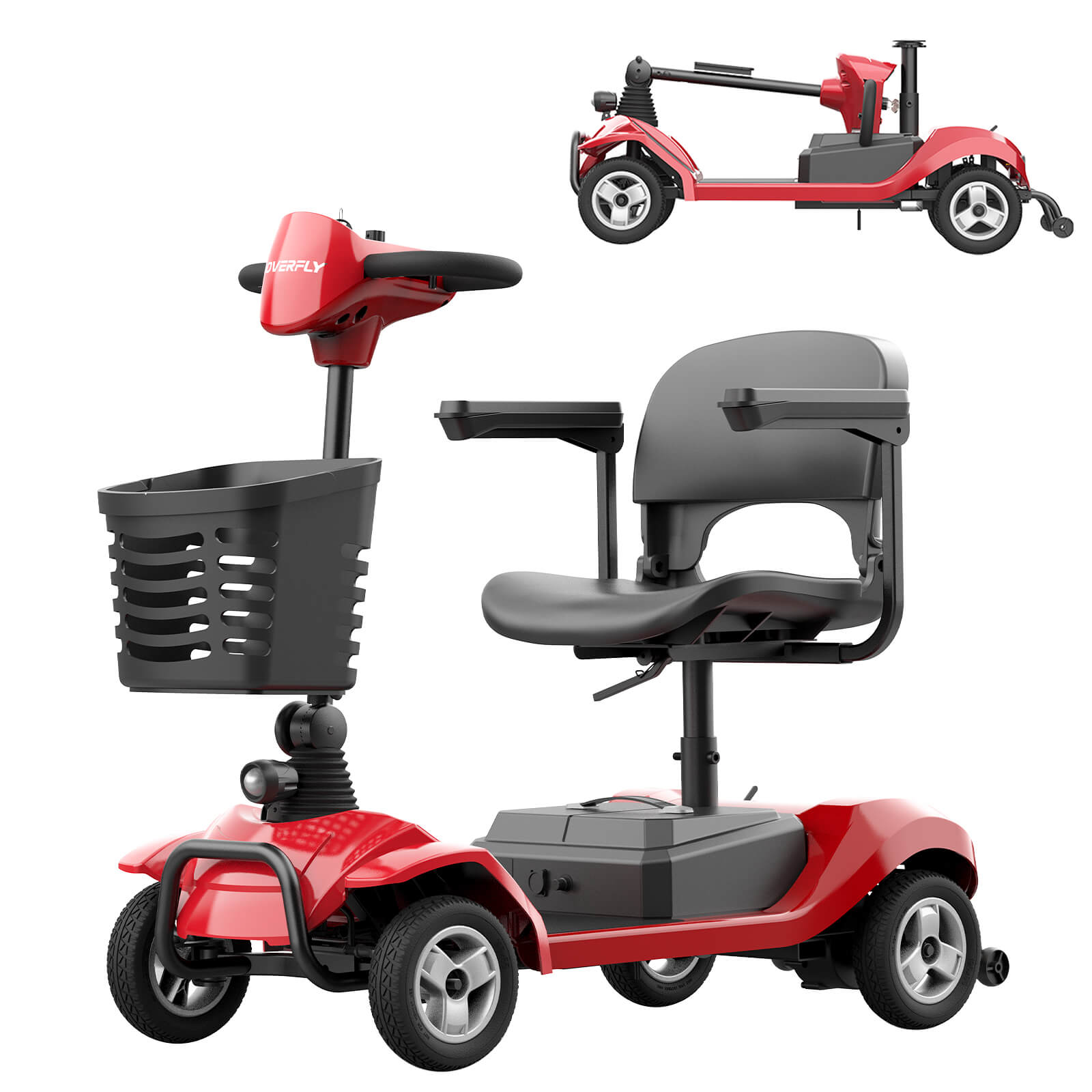 From the perspective of load and terrain adaptability, the efficiency of a four-wheel structure is equally significant. A standard four-wheel frame design can evenly distribute the user's weight (typically designed to support 150 kg) across four contact points, with the pressure standard deviation on each wheel being much lower than that of a three-wheel structure. This means that on soft or uneven surfaces such as grass and gravel, the probability of a four-wheeled vehicle getting stuck or slipping is reduced by approximately 35%. Industry innovation examples, such as Drive Medical's "RoughRider" series launched in 2025, utilize a four-wheel independent suspension system that absorbs over 70% of road surface vibrations, reducing the vibration transmitted to the rider by half. Test data clearly shows that in durability tests simulating rough terrain, the frame structure's fatigue life is 300 hours longer than competing three-wheeled vehicles.
However, a comprehensive evaluation must consider the specific application scenarios. Three-wheeled vehicles, with their smaller turning radius (as low as 1 meter) and lighter overall weight (an average of 15 kg lighter), possess an undeniable advantage in mobility indoors or in the relatively flat, dense urban environment. However, a study published in the *Journal of Rehabilitation and Assistive Technology* clearly indicates that when the usage involves even just two trips per week on unpaved outdoor surfaces, the overall safety benefits and maintenance costs (a 25% lower rate of component damage due to bumps) of four-wheeled mobility scooters make them a more sensible long-term investment. Therefore, the core of the choice is not a simple binary of good and bad, but based on an accurate assessment of the frequency and intensity of terrain "roughness": if there is a greater than 30% probability that your activity range includes non-standard road surfaces, then investing in a more robust four-wheeled mobility vehicle is undoubtedly a key strategy to reduce risk and increase freedom of outdoor exploration.
From the perspective of load and terrain adaptability, the efficiency of a four-wheel structure is equally significant. A standard four-wheel frame design can evenly distribute the user's weight (typically designed to support 150 kg) across four contact points, with the pressure standard deviation on each wheel being much lower than that of a three-wheel structure. This means that on soft or uneven surfaces such as grass and gravel, the probability of a four-wheeled vehicle getting stuck or slipping is reduced by approximately 35%. Industry innovation examples, such as Drive Medical's "RoughRider" series launched in 2025, utilize a four-wheel independent suspension system that absorbs over 70% of road surface vibrations, reducing the vibration transmitted to the rider by half. Test data clearly shows that in durability tests simulating rough terrain, the frame structure's fatigue life is 300 hours longer than competing three-wheeled vehicles.
However, a comprehensive evaluation must consider the specific application scenarios. Three-wheeled vehicles, with their smaller turning radius (as low as 1 meter) and lighter overall weight (an average of 15 kg lighter), possess an undeniable advantage in mobility indoors or in the relatively flat, dense urban environment. However, a study published in the *Journal of Rehabilitation and Assistive Technology* clearly indicates that when the usage involves even just two trips per week on unpaved outdoor surfaces, the overall safety benefits and maintenance costs (a 25% lower rate of component damage due to bumps) of four-wheeled mobility scooters make them a more sensible long-term investment. Therefore, the core of the choice is not a simple binary of good and bad, but based on an accurate assessment of the frequency and intensity of terrain "roughness": if there is a greater than 30% probability that your activity range includes non-standard road surfaces, then investing in a more robust four-wheeled mobility vehicle is undoubtedly a key strategy to reduce risk and increase freedom of outdoor exploration.
From the perspective of load and terrain adaptability, the efficiency of a four-wheel structure is equally significant. A standard four-wheel frame design can evenly distribute the user's weight (typically designed to support 150 kg) across four contact points, with the pressure standard deviation on each wheel being much lower than that of a three-wheel structure. This means that on soft or uneven surfaces such as grass and gravel, the probability of a four-wheeled vehicle getting stuck or slipping is reduced by approximately 35%. Industry innovation examples, such as Drive Medical's "RoughRider" series launched in 2025, utilize a four-wheel independent suspension system that absorbs over 70% of road surface vibrations, reducing the vibration transmitted to the rider by half. Test data clearly shows that in durability tests simulating rough terrain, the frame structure's fatigue life is 300 hours longer than competing three-wheeled vehicles.
However, a comprehensive evaluation must consider the specific application scenarios. Three-wheeled vehicles, with their smaller turning radius (as low as 1 meter) and lighter overall weight (an average of 15 kg lighter), possess an undeniable advantage in mobility indoors or in the relatively flat, dense urban environment. However, a study published in the *Journal of Rehabilitation and Assistive Technology* clearly indicates that when the usage involves even just two trips per week on unpaved outdoor surfaces, the overall safety benefits and maintenance costs (a 25% lower rate of component damage due to bumps) of four-wheeled mobility scooters make them a more sensible long-term investment. Therefore, the core of the choice is not a simple binary of good and bad, but based on an accurate assessment of the frequency and intensity of terrain "roughness": if there is a greater than 30% probability that your activity range includes non-standard road surfaces, then investing in a more robust four-wheeled mobility vehicle is undoubtedly a key strategy to reduce risk and increase freedom of outdoor exploration.
Working with Quang
Book a Portfolio Review →