
Budgeting Scent Training for a DTC Brand: The Line Items Nobody Quotes Upfront
Scent training is usually discussed as a single fee, and the fee is the least interesting number in the budget. For a direct-to-consumer brand the real cost is the sum of the course, the travel, the working days lost, the reference materials kept afterwards, the assessments, and the follow-up sessions that decide whether any of it survives. Add those and the decision changes: a cheaper course with follow-up usually beats an expensive one without, and the cheapest option of all is a habit the team already keeps.
Key takeaways
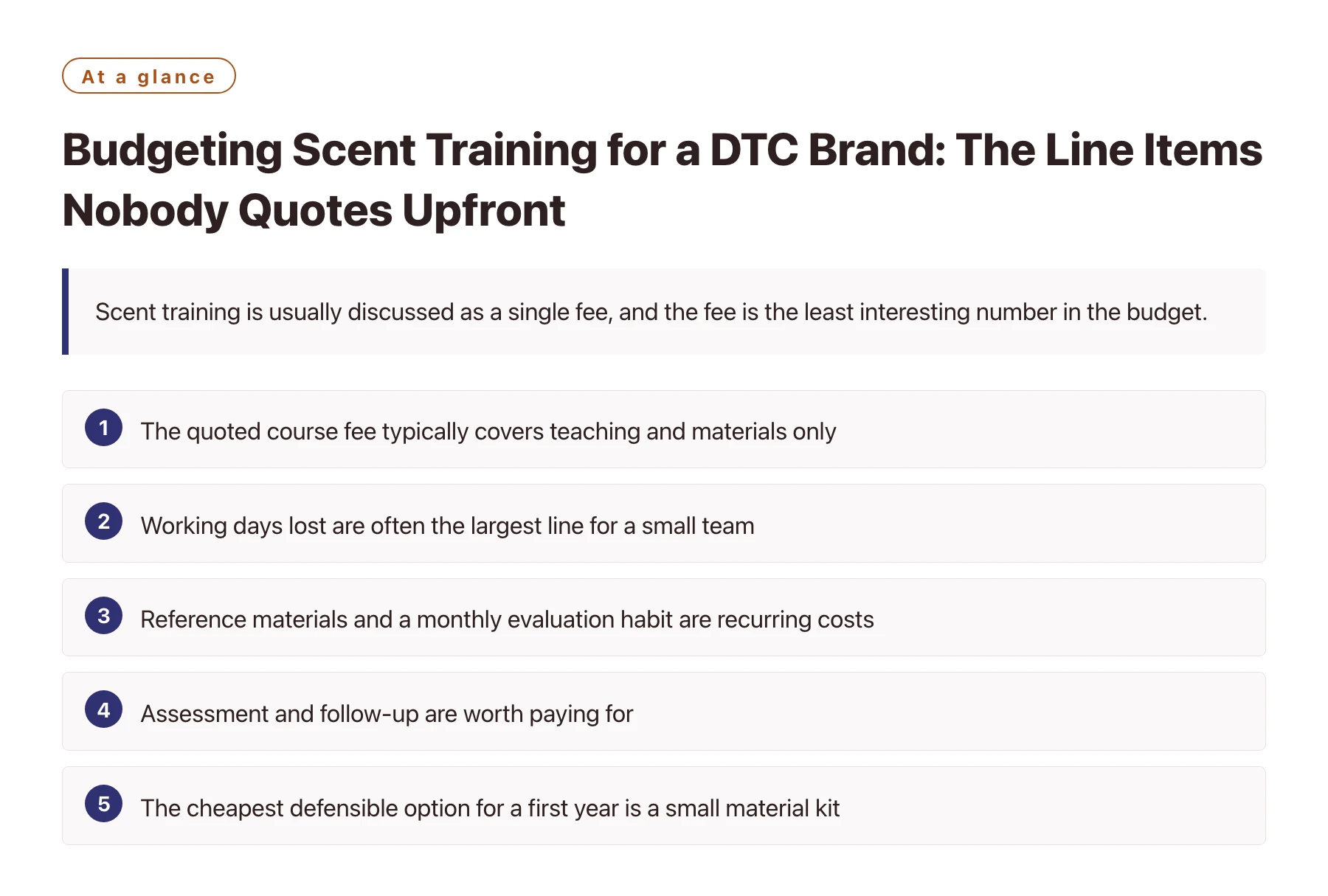
- The quoted course fee typically covers teaching and materials only; travel, lost working days and follow-up are separate costs that are rarely in the proposal.
- Working days lost are often the largest line for a small team, which is why a shorter shared session can cost less in total than a longer individual enrolment.
- Reference materials and a monthly evaluation habit are recurring costs, and they are the lines that determine whether the training still exists a year later.
- Assessment and follow-up are worth paying for, because they are what converts a taught skill into a change in how the team decides.
- The cheapest defensible option for a first year is a small material kit, a written vocabulary and a scheduled monthly session, with formal teaching added once a live project needs it.
Ask three training providers for a quote and each will return a number for the programme. None of them will return the full cost of the decision, because the rest of it sits in the buyer's own operation: flights, hotel, the days the team is not working on the product, the reference set that has to be bought separately, and the assessment or refresher that turns the course into a habit.
For a direct-to-consumer brand this matters more than for a larger company, because a small team has no slack. Losing three people for four days is not a travel expense, it is a week of product development that does not happen. That is a real cost, and it belongs in the comparison even though no invoice records it. Interest in scent as a point of difference has grown across consumer categories, and the pressure to make good sensory decisions early has grown with it [3].
The rest of this article sets out the line items, what each one buys, and where a brand can reasonably trim without destroying the value of the purchase. The intention is not to talk a team out of training; it is to make the budget honest enough that the decision survives its first internal review.
The full cost, line by line
| Line item | How it is usually charged | What it buys |
|---|---|---|
| Programme fee | Per person, per cohort, or per company for in-house sessions | Teaching time, a material set for the session, and access to a trainer |
| Travel and accommodation | At cost, and frequently underestimated for multi-day programmes | Attendance; nothing else, which is why it is the first line to question |
| Working days lost | Not invoiced, but real for a team of six or fewer | Absence from development, content and launch work for the duration |
| Reference materials | Bought separately, usually after the course | The physical standards that make vocabulary repeatable between sessions |
| Assessment or examination | Often included, sometimes an add-on | Evidence that participants can rank and describe consistently, not only attend |
| Follow-up or refresher | Sold as a package or booked later | The repetition that keeps the skill in use over the following year |
| Internal time to write it up | Nobody's budget, everybody's cost | A written vocabulary and evaluation protocol the team can actually apply |
Reading the table as a whole produces a different ranking from reading the programme fee alone. Travel and lost days frequently exceed the fee for a small team, and the two cheapest lines — reference materials and the internal write-up — are the ones that determine whether the purchase persists. A brand that budgets the fee and ignores the rest has planned for a week rather than for a capability.
Where the money can honestly be trimmed
The first candidate is travel. In-house sessions remove most of it and let the content be written around your own products, which is also better teaching. The trade-off is that an in-house session is only as good as the trainer, so the saving is real only if the provider has run this format before, which is also a fair question to ask of a contract manufacturer for perfume brands that offers sessions alongside a project.
The second is duration. A shorter programme attended by the whole team usually beats a longer one attended by one person, both in total cost and in effect, unless the goal is genuinely to create a specialist. Deciding which of those two goals you have is the single most valuable thing to do before requesting quotes.
The third is the material kit, which is where caution is warranted. A team can save money by skipping it and then lose far more by having no shared standards to evaluate against. Even a modest kit pays for itself the first time a disagreement is settled by smelling the same reference rather than by arguing.
What a serious programme includes
Industry material on perfumery education describes programmes built around three elements: structured material study, guided evaluation practice, and assessment against references rather than against the room's opinion [1]. When comparing quotes it is worth checking which of the three a proposal actually contains, because programmes that omit assessment are usually the ones that feel satisfying and change nothing. Reading the published outlines of perfumery education programs is a quick way to see what those three elements look like in practice before you compare fees.
Technical publications in this industry also document how materials are evaluated, classified and substituted, which is useful context when deciding how deep a brand needs to go [2]. A team that will mostly make commercial decisions does not need formulation-level depth; a team that intends to brief a perfumer in detail does. It is a similar skill to reading a perfume price breakdown: knowing which lines carry the real cost is what lets you ask a useful question rather than a general one.
Why the cheapest line matters most
Writing up what the team learned sounds like an afterthought, and in most budgets it is not costed at all. In practice it is the highest-return line in the table, because it converts a private experience into an internal document: agreed words, agreed references, agreed evaluation conditions. An afternoon of work can make a modest course worth more than an expensive one.
The same logic applies to follow-up. A single refresher session three months later, run internally against the reference set, costs little and catches the drift that always happens. Brands that skip it tend to rebuy training a year later without noticing they are paying twice for the same capability.
If the budget has to be defended to a co-founder or an investor, present it as three numbers: the cost of the programme plus travel, the working days it removes, and the expected reduction in wasted sample rounds. The third is the one that pays for the first two, and it is measurable. A brand that can show rounds falling from four to two has a stronger argument for its next training purchase than any certificate, and the same discipline applies when you compare what a manufacturer such as Xuelei includes in a development project.
Sources
- The Fragrance Foundation —— A non-profit organisation for the fragrance industry, running perfumery education programmes and industry recognition.
- Cosmetics & Toiletries —— A technical magazine for cosmetic formulators, covering ingredients, formulation science and testing methods.
- Mintel Press Centre —— Mintel's press releases on consumer and beauty market research, including fragrance and personal care trend reporting.
Frequently asked questions
Is scent training worth the money for a small DTC brand?
It depends on what the alternative costs. If a weak brief and inconsistent feedback are causing an extra sampling round per launch, training can be cheaper than the rounds it prevents. If the brief is already clear and the team agrees quickly, the money is usually better spent on development or on packaging.
How much should a brand budget for reference materials?
Less than most people expect, and it is a recurring rather than a one-off cost because materials are consumed and need replacing. The sensible approach is to start with a small set covering the families the brand sells, and to add materials as questions come up rather than buying a comprehensive library at the outset.
Should assessment be a deciding factor when choosing a provider?
Yes, because it is the only part of a programme that demonstrates the skill was acquired. Assessment can be light, such as a ranking exercise marked against known references, but a proposal with none at all is usually teaching exposure rather than capability, and the difference shows up at the next sampling round.
Can training costs be folded into a development project?
Sometimes, when the manufacturer runs both. A session built around your live brief and your own candidate directions serves the project as well as the team, and it is reasonable to ask whether that can be included or discounted. It should still be budgeted separately so the value is visible rather than hidden in a unit price.
What is the most common way brands waste a training budget?
Paying for depth that nobody will use. A small team that sends one person on a long specialist programme often ends up with knowledge that cannot be applied internally, while the team's actual weakness in ranking and describing scents remains. Matching the format to the size of the team is the simplest way to avoid it.