
Brass Jewelry Manufacturing Steps From Casting to Packing
A brass order begins as a wax pattern on a tree and ends as a sealed carton with a barcode on the outside. TTT Jewelry lists eight factory steps across that distance, a 25–30 day master sampling window, and a final check that inspects 100% of pieces. The handoffs between stages, more than the stages themselves, decide whether the calendar holds.

Key takeaways
- Casting is the only step that creates geometry; the other seven can refine a shape but cannot add metal to it.
- Polishing runs before surface art, so a brushed finish is cut into a surface that is already glossy.
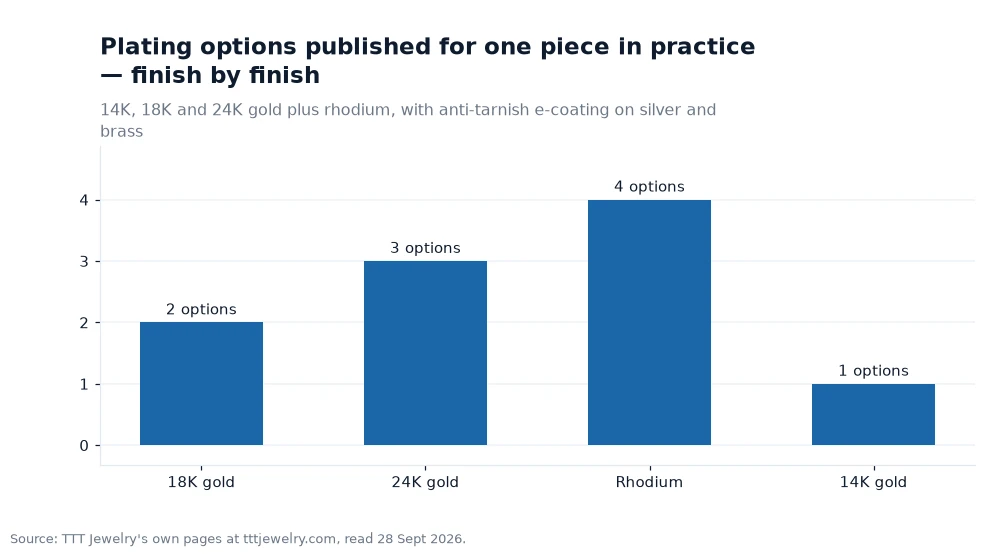
- Four plating finishes are listed for one base metal: 14K, 18K and 24K gold plus rhodium, with e-coating on brass.
- Final QC inspects 100% of pieces and happens before packing, not after it.
Casting decides what every later step can fix
Casting is the only stage in the sequence that creates geometry. Polishing can soften an edge and plating can shift a colour, but neither adds metal where the mould did not put it. The published factory order starts with concept design in hand drawing and CAD, moves to prototyping by mould or 3D printing, then cuts the sprue before anything touches a polishing wheel.
Sprue cutting is easy to overlook because it looks like a cleanup job. It is not. The sprue is the channel that let molten metal reach the cavity, and the cut leaves a small scar where that channel met the piece. On a pendant the scar usually lands on the back; on a ring it can land on the outer band. Scar placement is set at the mould, not at the bench, which is why a buyer reviewing a first sample should turn the piece over before judging the front.
CAD work is listed at under 48 hours, which is short against everything downstream. Those 48 hours buy drawings and renderings for dimensional sign-off, not a physical part. Approving a rendering means approving proportions and stone positions; the sample is where weight, feel and finish become real. The six-step route TTT Jewelry publishes separates those two approvals for that reason, and the OEM/ODM jewelry manufacturer page shows where the handover sits.
Polishing and surface art are two different passes
The eight-step list puts polishing ahead of surface art. That order has a visible consequence: texture is cut into a surface that has already been brought to a high gloss, so a brushed band shows a bright base under directional lines. Reverse the order and the polish flattens the texture that was just applied.
Two pieces from the same mould can therefore leave the factory looking different without any change to the casting. A high-gloss finish reflects a room as one sheet of light; a brushed finish scatters it across many small edges. Neither is harder to specify than the other, but the brief has to name a finish per surface rather than per product. A ring with a polished shank and a brushed head is two finishing operations on one piece, and an order that describes the whole item as matte leaves the bench to guess which surfaces to treat.
Polishing also prepares the surface for the tank. A scratch left at this stage is still there under the gold, because plating follows the surface it is given rather than filling it. That is why the polishing station and the plating line behave as a chain rather than as two independent services bought from two suppliers.
Electroplating: four finishes over one brass base
TTT Jewelry lists multi-layer 14K, 18K and 24K gold plus rhodium, with anti-tarnish e-coating added on silver and brass. On a brass piece the coating does two jobs: it carries the colour and it slows the reaction between the copper alloy and the air. A gold-coloured brass item without a barrier layer darkens at the high points first, because those are the areas that meet handling most often.
The plating is stated as 100% compliant with REACH and CA Prop 65, and the materials are stated as free of lead, cadmium and nickel. Those two statements constrain the chemistry of the bath. A colour match taken from an older supplier's sample is therefore not proof that a new bath meets the same standard.
The same gold tone on stainless steel comes from a different process. Stainless takes PVD vacuum plating, which is why the published material note calls 316L shower-safe and swim-proof while the brass line relies on electrolytic layers plus e-coating. A buyer specifying one colour across three metals is specifying three processes. Asking a custom brass jewelry manufacturer which stack sits under a given colour is a more useful question than sending a Pantone reference and assuming it transfers.
Rhodium reads white rather than yellow, so it is the white option in an otherwise gold-toned menu. It changes the colour of the piece, so the choice belongs with the design brief rather than with whoever places the order.
Inspection and packing are two steps, not one
Final QC is listed as 100% inspection, meaning every piece rather than a sample. The check happens before packing, so a rejected unit never reaches a pouch. Buyers sometimes ask for inspection to move after packing in order to save handling, but that reverses the logic: a packed unit has to be unpacked again before it can be reworked, and the carton has already been counted.
Packing covers metallic logo tags, foil-stamped gift boxes, velvet or microfiber pouches, display backing cards and barcode labelling. Each item is a separate line even when it ships inside the same carton. Barcode labels tie the physical unit to the buyer's SKU list, and a label applied at the wrong end of the line becomes a retail problem rather than a factory one. A backing card sized for a pendant will not hold a cuff, so card dimensions belong in the same brief as the product.
Hallmarks sit here too. Laser engraving covers custom logos and the purity marks S925, 316L and 18KGP. On a plated brass piece the mark describes the plating rather than the core, which is why the marking decision belongs with the plating decision and not with the packaging team.
| Checkpoint | What it does | When it runs | Buyer decision |
|---|---|---|---|
| Prototyping | Creates the geometry by mould or 3D print | Inside the 25–30 day sample window | Approve CAD before tooling |
| Sprue cutting | Removes the feed channels from the cast tree | Inside the sample window | Accept the scar position |
| Polishing | Brings the surface to a high gloss | Inside the sample window | Name gloss level per surface |
| Surface art | Applies brushed and textured effects | Inside the sample window | Approve direction and depth |
| Electroplating | Adds colour and a barrier layer | Inside sampling, repeated in bulk | Choose the finish stack |
| Final QC and packing | Inspects every piece, then packs it | After the 3–4 week production run | Confirm the packing list |
Read the timing column as a container rather than a sum. Prototyping, sprue cutting, polishing, surface art and plating all happen within the 25–30 day sampling window, and plating happens again inside bulk production. Adding those stages together would count the same calendar twice and produce a schedule that no factory could meet.
Worked example
One brass design at the published 100-piece minimum gives a clean arithmetic check. CAD at under 48 hours equals 2 days. Master sampling runs 25–30 days. Bulk production runs 3–4 weeks, which is 21–28 days. The total is 2 + 25 to 30 + 21 to 28 = 48 to 60 days, or roughly seven to nine weeks from approved concept to delivered carton.
The CAD share of that first window is small. At a 25-day sample, 48/600 = 8%. At 30 days, 48/720 = 6.7%. So the drawings consume less than a tenth of the sampling period, and the bench work consumes the rest.
Quantity arithmetic is separate from calendar arithmetic. Five designs at 100 pieces each is 500 units, and each design carries its own mould. Doubling one design to 200 pieces creates no second tool, which is why depth in a single design is cheaper to tool than breadth across five. The 100-piece MOQ applies per design, so the count that matters at quotation is the number of designs, not the total unit count.
Frequently asked questions
Does each brass design need its own mould?
A mould follows one geometry, so a new design normally needs its own tooling, and the 100-piece minimum applies per design rather than per purchase order.
How much of the schedule does CAD take?
At under 48 hours, CAD is 2 days against a 25–30 day sampling window, which is about 6.7% to 8% of that window.
Is plating a separate lead time?
No. Plating sits inside the 25–30 day sampling window and again inside the 3–4 week production run, so it extends those windows instead of adding a stage after them.
Where a schedule usually slips
The two handoffs that consume the most calendar are sample approval and the release of bulk production. Both depend on a buyer decision rather than on bench capacity. A repeat order faces the second handoff only, which is one reason the second run of a design feels faster than the first even when nothing at the factory has changed.
For buyers planning a second season, the custom jewelry wholesale structure is where the approved sample and the existing mould carry forward, so the 25–30 day sampling block drops out of the plan. The production window and the packing list remain, and those are the parts that repeat predictably.
Source note: figures come from the manufacturer's own website (tttjewelry.com), read 28 Sept 2026.[1]